Your Restaurant's AI Now Has to Introduce Itself
Two things happened to restaurants this summer, and almost nobody has put them in the same sentence.
The first is a forecast. Hospitality analysts have settled on a phrase for 2026: invisible AI — systems that quietly handle loyalty, forecasting, dynamic pricing and upsell without the guest ever noticing there was a model in the room. The pitch is that good AI is the kind you cannot see.
The second is a law. On 2 August 2026, Article 50 of the EU AI Act became applicable. In one line: when a person is interacting directly with an AI system, they have to be told, from the start of the first interaction, in a clear and distinguishable way, unless it is obvious.
So the industry wants the AI invisible, and for anything that speaks to a guest the law wants it announced. Both can be right, because they are describing different machines. Working out which of your machines is which is the actual job — and this article is about the one that sits on the table.
Two out of ten diners already ask a machine where to eat
The behaviour arrived before the rulebook. Roughly 22% of US diners say they have already asked an AI tool such as ChatGPT or Gemini where to eat, and about 44% of Americans expect to lean on AI for discovery and booking more in 2026 than they did the year before. That is not a pilot programme. That is a habit.
The uncomfortable half comes from Uberall's 2026 benchmark of how assistants actually answer those questions: 83% of restaurant locations never appear in AI-generated recommendations at all, even though the overwhelming majority maintain a Google presence. Being findable on a map is no longer the same thing as being recommended by a machine.
And when the assistants do recommend somewhere, look at what they are reading. The citations cluster around editorial best-of lists, then user-generated threads like Reddit, then review and booking platforms. Restaurants' own websites barely register as a source. In other words: the AI describing your food to a stranger is working from other people's writing about you, and your actual menu is nowhere in the answer.
Discovery and the table are two different problems
Let us be blunt about the half we cannot fix. You do not win AI discovery with a menu page. That is a reputation game — reviews, ratings, being mentioned in the lists that assistants keep quoting, keeping your business profile accurate. A public ShareCut menu is served noindex on purpose, so it will never be the thing that gets you into a ChatGPT answer, and any vendor telling you otherwise is selling you something.
The second moment is entirely yours, and it is the one almost nobody has furnished. The guest is already seated. The phone is already in their hand. They open your QR menu, they scroll, they hesitate. If they ask a general assistant what to order here, it will answer from a scraped copy of a menu you replaced two seasons ago, or from nothing at all. That answer will be confident, plausible, and occasionally about a dish you have never served. It is, functionally, your worst reviewer — and you are paying nothing for it because you never noticed it was speaking.
What “it cannot invent a dish” actually means
Restaurant Buddy is our answer to that moment, and the interesting part is how little of it is a chatbot.
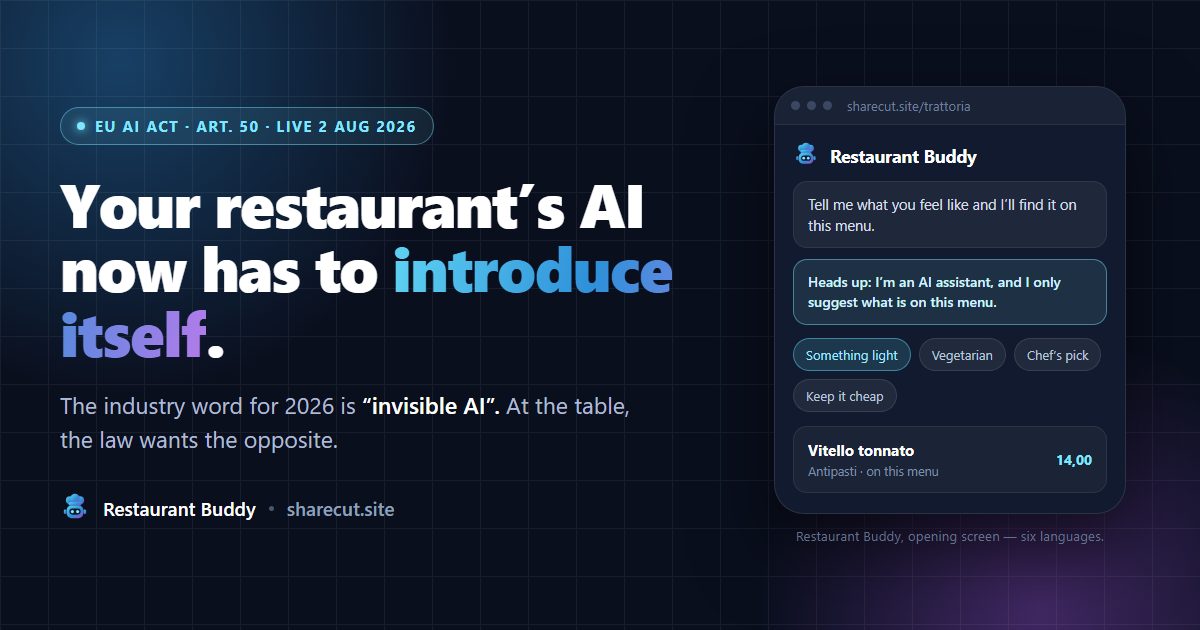
Every dish Buddy names is validated against an item ID in the menu you published. The price is re-read from the menu rather than written by a model. That is not a prompt instruction asking a model to behave — it is a check that rejects the answer if the dish is not there. A general assistant cannot make that promise, because it has nothing to check against.
Underneath, the selection engine is deterministic and runs on every plan. Tapping a chip — something light, vegetarian, the chef's pick — calls no model at all, which is why the answer is instant and why correcting yourself costs nothing. The median guest session makes zero or one model call in total. AI does exactly three jobs: it reads a menu once per version to learn that menu's own vocabulary, it parses a sentence when a guest types one in their own words, and on the Business plan it writes a short preface to the recommendation.
Safety works the same way, deliberately. A confirmed allergen or dietary constraint filters the menu. A model merely reading “no nuts” out of a sentence does not — the guest has to tap a confirmation first, because a parser being 95% right is not good enough when the remaining 5% is an allergy. And Buddy still tells the guest to check with the staff, because a menu is a document and a kitchen is a place.
Where Article 50 actually lands, and it is probably not on you
Here is the part most restaurant coverage has got backwards. Under Article 50(1) the duty sits with the provider of the AI system — the party that designs and ships it — to build it so that the person is informed they are dealing with an AI. It is a design obligation, not a poster you print.
The obligation bites when four conditions hold together: the thing is an AI system; it is built for genuine two-way exchange rather than canned replies; the interaction is direct; and it is with a real person. The “unless it is obvious” carve-out exists, but the Commission's guidance says it should be read restrictively, measured against an average person who is reasonably well informed, circumspect and observant. Assuming your guests will simply work it out is not a strategy. Enforcement carries penalties of up to 15 million euro or 3% of worldwide annual turnover. None of this is legal advice, and a lawyer who knows your setup is worth an hour of your time.
The practical consequence for an operator is a relief and a warning at once. Switch on an assistant your vendor built and ships, and the design duty is theirs. Bolt a generic chatbot onto your menu, put your restaurant's name on it and change how it behaves, and you may have walked into provider territory without meaning to.
Which is why, from this week, Buddy opens with a line. Not a modal, not a cookie-style banner, not a box to tick: one muted sentence under the first question, in Buddy's own voice — Heads up: I'm an AI assistant, and I only suggest what is on this menu — in all six languages. It appears only on menus where the guest can type, because that is the only path with a model in the loop; tapping chips runs the deterministic engine and calls nothing, so a chips-only menu is unchanged. It cost one string, and it is the first thing the guest reads.
Four questions worth asking any menu-AI vendor
- Does it say what it is before the first answer? Not in the terms of service. On screen, where the guest is looking.
- Can it name a dish that is not on my menu today? Do not accept a promise. Ask them to describe the mechanism that makes it impossible.
- Where does the price come from — my menu, or the model? If a model writes prices, one day it will write the wrong one, and the guest will show it to your server.
- What happens when the AI is unavailable? An error message in front of a guest is worse than no assistant. The answer you want is that it degrades to something that still works.
What it costs, and where it stops
Restaurant Buddy is part of the Restaurant plan at 19 euro a month and the Business plan at 29 euro a month. It is not on Free or Pro, with or without AI. The AI is included in those plans and billed to us, up to 1,500 requests a month on Restaurant and 4,000 on Business; past the cap Buddy keeps working on the deterministic engine rather than showing an error. Connecting your own provider key removes our cap entirely.
A menu holds up to 400 dishes on Restaurant and 500 on Business, and you can import a printed one from a PDF or photos — up to 4 MB per import — then review every row before anything goes live. Buddy speaks six languages: English, Italian, Spanish, French, German and Portuguese, the same six the menu itself supports.
What it does not do, said plainly: it does not take orders, it does not process payments, it does not replace a server who knows the room, and it will not get you into an AI's recommendations for your city. It also will not quietly push your highest-margin plate unless you decide that is what you want; margin is a tiebreak you switch on, not the default. And if you ever stop paying, the QR code you printed keeps resolving and the menu keeps rendering — Buddy switches off, the page does not die.
The line most menus are still missing
An AI at the table is not risky because it is an AI. It becomes risky in exactly two ways: when nobody told the guest what they were talking to, and when it can talk fluently about food you do not serve. Both of those are design choices, and both were made before the guest ever sat down — by you, or by whoever built the thing you switched on.
The 2026 fashion for invisible AI is right about the back office and wrong about the dining room. Forecasting, rostering, inventory: be as invisible as you like. The moment a machine starts making suggestions to a human being about what to put in their mouth, invisibility stops being elegance and starts being a liability. It costs one sentence to fix. We know, because that is exactly what it cost us.
If you already run a QR menu, you can see the whole thing working in an afternoon: build the menu, import the printed one if you have it, turn Buddy on, and read what it says to your guests before they do. Compare the plans or start with the digital menu builder — and if you want the version of this argument that is about wine rather than law, we wrote about the sommelier at every table last week.
One question, and we would genuinely like the argument: if the assistant on your menu had to open with “you are talking to an AI”, would you still switch it on?